
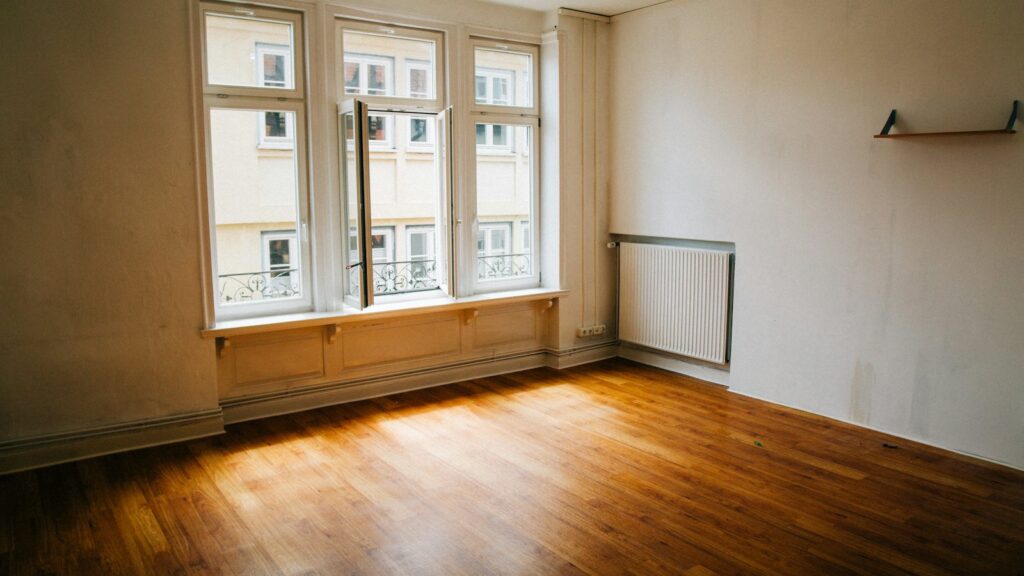
A home left empty for more than twelve months can cost its owner dearly: in Brussels, EUR 500 per metre of façade and per storey, every year; in Wallonia, between EUR 500 and EUR 12,500; in Flanders, a municipal tax that rises year after year. For an agency, the answer comes down to two things: re-let quickly, and document any vacancy that drags on.
When is a home considered vacant in Brussels?
The Brussels Housing Code defines a vacant home as one that has not been occupied in line with its residential purpose for more than twelve consecutive months (Article 19/2). The offence consists, for the holder of a right in rem, in keeping that home empty without justifying the vacancy by legitimate reasons, force majeure, or the planning or carrying out of works (Article 19/1). Article 19/3 lists presumptions, valid until proven otherwise. Nobody is registered at the address, no residential lease is registered for it, and the home is not furnished. Water consumption is below five cubic metres a year, or electricity consumption below one hundred kilowatt-hours a year. The clock starts when the home is actually vacated, not at the notice. For an agency, this is the key point: a home re-let during the outgoing tenant’s notice period never falls within the scope.
How much is the Brussels fine?
The procedure is run by the Regional Vacant Housing Service, which records the presumed offence in an official report, on its own initiative or following a complaint from a municipality or an association. The owner receives a warning and has three months to put forward a defence. If the presumption is not rebutted, Article 20 sets the fine at EUR 500 per linear metre of the longest façade, multiplied by the number of storeys other than basements and unconverted attics. It is multiplied by the number of years following the first finding, not counting years in which an interruption of at least three months can be established. Take a house with a 6-metre façade over three storeys: 6 × 3 × 500 = EUR 9,000 for the first year of the offence. The owner has thirty days to lodge a suspensive appeal with the Government (Article 21). For an owner, this figure is the most concrete argument for accepting a quick re-letting at a realistic rent.
Are these fines actually applied?
Yes. According to the 2025 activity report of Brussels Housing, the service carried out 2,898 investigations in 2025 for 2,356 files, with a team reduced to 7 investigators instead of 11. It imposed 257 fines; after appeal, 243 were confirmed for a total of EUR 2,733,000. The amount actually collected in 2025 was EUR 1,557,000.
What fine applies in Wallonia?
In Wallonia, Article 85ter of the Walloon Sustainable Housing Code provides for an administrative fine of between EUR 500 and EUR 12,500 per home per twelve-month period without an interruption of vacancy of at least three months. An order of the Walloon Government of 19 January 2022, in force since 1 September 2022, sets the calculation. The fine is EUR 200 per linear metre of the main façade, the one with the main entrance door, multiplied by the number of vacant storeys, excluding cellars, basements and unconverted attics. It is kept between EUR 500 and EUR 12,500, then multiplied by the number of years following the first finding. Two differences matter for an agency. First, it is the municipal college that records the offence and imposes the fine, not the Region. Second, the fine is only possible if no municipal vacancy tax has been levied for the financial year. According to the Union of Walloon Cities and Municipalities, the procedure involves three letters: a warning with a six-month formal notice, a second notice to put forward a defence, then the decision.
And in Flanders?
In Flanders, vacancy is a matter for municipalities. Under the Flemish Housing Code, municipalities may keep a register of vacant buildings and homes, which is the only possible basis for a municipal tax (Article 2.9). A home is entered if it has not been used in line with its function for at least twelve consecutive months (Article 2.10). It is removed when the holder proves compliant use for at least six consecutive months (Article 2.11). Exemptions and amounts are set by each municipality’s regulation. According to the Region’s brochure Leegstand bestrijden, 282 of the 300 Flemish municipalities had a tax regulation in mid-2023. The average amount for a single-family home taxed for the first time was EUR 1,467. In Landen, the tax is EUR 1,500 for a home, multiplied by 1.5 per additional twelve-month period in the register, up to four periods. Hoegaarden applies EUR 1,600 with the same coefficient.
How can a home be re-let before the clock starts?
The surest way to avoid the fine is never to reach twelve months. A few habits are enough in most cases:
- Start re-letting from the notice period: viewings, listing, photos, in agreement with the outgoing tenant and in line with the lease’s viewing clause.
- Plan works before move-out: quotes, contractors and schedule ready for the day of the check-out inventory.
- Set a realistic rent with the owner, showing them the cost of a prolonged vacancy.
- Track every empty property with its move-out date and an alert well before the twelfth month.
The end of the lease itself is covered in our article on end of lease, damage and arrears. In Wallonia, the rental deposit is released under its own rules.
What should be documented to justify a vacancy?
In Brussels, Article 20 is demanding: merely alleging facts is not enough. The owner must prove that the home was not vacant, that the vacancy was due to a legitimate reason beyond their control or to force majeure, or that it was justified by works. For works carried out, it must be shown that they were conducted effectively, continuously and diligently. For planned works, effective steps must be proven, along with the fact that the planning made any occupation impossible, even temporary or partial. The agency can build this file as it goes:
- the move-out date and the check-out inventory;
- quotes, purchase orders, invoices and dated photos of the works;
- permit applications and their timelines, where relevant;
- listings, viewings and rejected applications during re-letting;
- documents relating to an estate or dispute that blocks letting.
For renovations funded by the tenant in Wallonia, see also our article on the Walloon renovation lease.
How does Seido help during a vacancy?
Managing several properties? In Seido, each maintenance job is tracked step by step, from request to closure, with the assigned contractor, the scheduled date and before-and-after photos. Works between two tenants thus leave a dated trail, useful both for re-letting quickly and for justifying a vacancy. See how real-time job tracking works.
Frequently asked questions
Does the twelve-month period start at the notice or when the tenant leaves?
When the tenant leaves. In Brussels, Article 19/2 targets a home that has not been occupied in line with its purpose for more than twelve consecutive months. During the notice period, the tenant still occupies the home. This is why re-letting during the notice period means the clock never starts. In Flanders, the municipal register also uses a period of at least twelve consecutive months without compliant use.
Do renovation works justify a vacancy?
Yes, provided they are proven. In Brussels, a vacancy justified by works being carried out requires proof that they are conducted effectively, continuously and diligently. For works that are only planned, effective steps and the impossibility of any occupation, even partial, must be demonstrated. A site that stands idle for months is not enough.
Does the owner pay the same fine every year?
No, the amount rises. In Brussels as in Wallonia, the fine is multiplied by the number of years following the first finding, not counting years in which an interruption of at least three months can be established. In Flanders, municipal regulations often provide a coefficient per additional twelve-month period, such as 1.5 in Landen.
Who receives the fine: the owner or the agency?
The holder of the right in rem, meaning the owner, not the agency. In Brussels, co-holders are jointly liable, and the fine is secured by a legal mortgage (Article 22). The agency is not liable for the fine, but it often holds the documents needed to challenge it: dates, quotes, invoices, listings. Hence the value of keeping them on the property record.
Sources and references
- Brussels Housing Code, Articles 19/1 to 22, consolidated text, Justel
- Rapport d’activité 2025 (2025 activity report), Brussels Housing, 29 June 2026, pp. 14-17
- Walloon Sustainable Housing Code, Articles 80 and 85ter, Wallex
- Order of the Walloon Government of 19 January 2022 on the administrative fine of Article 85ter, Justel
- Logements inoccupés : entrée en vigueur de l’amende administrative, Union of Walloon Cities and Municipalities, 1 September 2022
- Vlaamse Codex Wonen van 2021 (Flemish Housing Code), Articles 2.9 to 2.14, Codex Vlaanderen
- Leegstand bestrijden, Wonen in Vlaanderen, March 2025
- Leegstand, municipality of Landen
- Registratie en gemeentebelasting op leegstand, municipality of Hoegaarden
Last updated: August 2026. This article is provided for information purposes only and does not constitute legal advice. For any specific situation, consult a real estate law professional.